|
 
 
|
BRIEF HISTORY
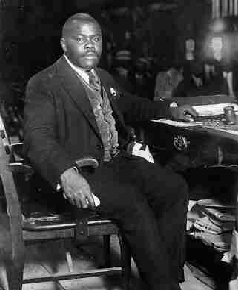
Marcus Mosiah Garvey (1887-1940), devoted his life to the
cause of correcting the injustices that blacks were
subjected to, everywhere they were found. Garvey,
in 1914, founded and became the charismatic leader of the
Universal Negro Improvement Association (U.N.I.A.). Its
purpose was to improve the conditions of black people
everywhere. He was convinced that success demanded the
building of a strong economic base so that blacks will be
self-sufficient. This led to the establishment of
various business ventures, including the Black Star Line,
The Negro Factories Corporation and The Negro World.
These efforts at economic independence were variously
successful. However, through the U.N.I.A., Garvey was
extremely successful in educating blacks about their
history and of their inherent strengths. In fact,
he was masterful in his ability to mobilize millions of
supporters to the black issues of the day.
|
Truly, for many blacks, Garvey provided a vision of the
endless possibilities once they systematically eroded the
barriers to their success. Many felt a renewed sense of
dignity, and of destiny, through Garvey's unceasing
advocacy.
In 1922, the promise that Garvey represented was
shattered by the charges brought against him by the
United States: mail fraud. They tried, convicted, and
sentenced him to five years in prison. He served two
years and nine months, was released and deported to his
homeland, Jamaica. Discredited, he sought to revive the
U.N.I.A. and so he left Jamaica for England, where he
died in 1940. With his death, the monumental impact of
his life and work became more broadly recognized and
acknowledged. He was inducted as Jamaica's first national
hero, and leaders like Kwame Nkrumah, Malcolm X, and
Martin Luther King, Jr. cite him as the inspiration for
their work. Today, Marcus Garvey is revered as a hallmark
of black leadership and one of the great visionaries of
this century.
|